How to Calculate Your Freelance Rate
Most freelancers pick a rate by looking at what others charge, then wonder why they're busy but broke. Here's a better way: work backwards from the life you need to fund, and let the maths tell you your minimum.
Why "market rate" is the wrong starting point
Looking at other freelancers' rates tells you what the market will tolerate. It doesn't tell you what you need. Two designers charging $60 an hour can have completely different outcomes: one lives somewhere cheap, works 35 billable hours a week and has no software costs; the other pays for a studio, an Adobe subscription and health insurance, and spends half the week on admin and sales. Same rate, very different businesses.
So start with your own numbers. Once you know your floor – the rate below which you're effectively paying to work – you can look at the market to decide how far above that floor you can price.
The freelance rate formula
Here's the whole thing in one line:
Each part does a specific job:
- Take-home income goal – what you want to pay yourself for the year, after tax. Think of it as your salary.
- Business expenses – everything the business pays for: software, hardware, insurance, accounting, coworking, training, website, bank fees.
- Tax rate – a realistic blended estimate of income tax plus self-employment or social contributions. Dividing by (1 − tax) "grosses up" your number so the tax comes out of revenue, not your salary.
- Profit buffer – a margin for slow months, late payers, equipment that dies and future growth. Employees have an employer absorbing this risk; you don't.
- Billable hours – the hours you can actually invoice for. This is where most people get it badly wrong.
Step 1: Set your income goal
Add up your real yearly personal costs – rent, food, transport, debt, family, holidays – then add what you want to save or invest. Don't use a wishful number and don't use a guilty number. If you were previously employed, your old net salary is a sensible baseline, but remember that freelancing usually removes perks like paid leave, pension contributions and equipment.
Step 2: List your business expenses
Go through your bank statements for the last few months and pull out anything business-related. Annualise subscriptions (a $25/month tool is $300 a year). Include things you'll need to replace: if your laptop costs $1,800 and lasts three years, that's $600 a year. If you track income and expenses as you go, this step takes five minutes instead of an afternoon.
Step 3: Estimate tax honestly
Tax rules vary by country, so check with a local accountant, but a blended rate between 20% and 35% is typical for many freelancers once social or self-employment contributions are included. If you're unsure, err slightly high. Over-saving for tax is a pleasant surprise; under-saving is a crisis in April.
Step 4: Count your real billable hours
A year has 52 weeks, but you won't work all of them. Subtract public holidays, vacation and a few sick days – six weeks off is a reasonable starting assumption. Then accept that not every working hour is billable. Emails, proposals, invoicing, marketing, bookkeeping, learning and finding the next client all take time. Many freelancers bill 50–70% of their working hours; newer freelancers who are still building a pipeline are often at the lower end.
A worked example
Let's run the numbers for Maya, a freelance web designer.
| Input | Value |
|---|---|
| Take-home income goal | $60,000 |
| Business expenses (software, laptop, insurance, accountant, coworking) | $6,000 |
| Blended tax rate | 25% |
| Profit buffer | 10% |
| Weeks off (holidays, vacation, sick) | 6 |
| Hours worked per week | 40 |
| Billable share of time | 60% |
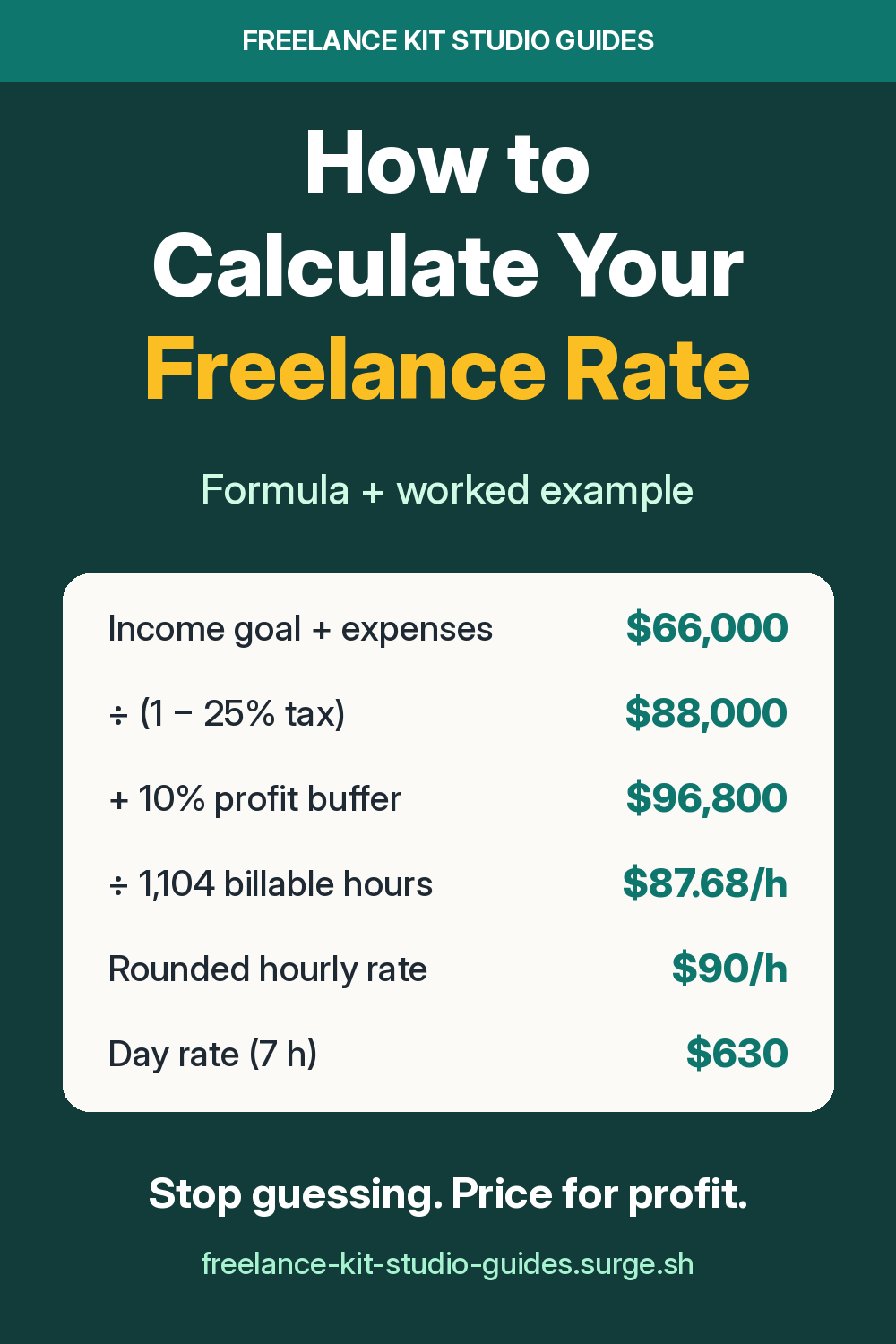
1. Cover income and costs: $60,000 + $6,000 = $66,000.
2. Gross up for tax: $66,000 ÷ (1 − 0.25) = $66,000 ÷ 0.75 = $88,000.
3. Add the profit buffer: $88,000 × 1.10 = $96,800 revenue target for the year.
4. Work out billable hours: 52 − 6 = 46 working weeks. 46 × 40 = 1,840 working hours. 1,840 × 0.60 = 1,104 billable hours.
5. Divide: $96,800 ÷ 1,104 = $87.68 per hour.
That's Maya's floor. She rounds up to $90/hour. Notice what would have happened if she'd assumed every working hour was billable: $96,800 ÷ 1,840 = $52.61. Charging that, she'd fall almost $39,000 short of her target. The billable-hours assumption is the single biggest lever in the whole calculation.
Turning the hourly rate into day and project prices
Clients often prefer day rates or fixed prices, and so should you – they reward you for getting faster. From the same number:
- Day rate: $90 × 7 billable hours = $630/day.
- Monthly revenue target: $96,800 ÷ 12 ≈ $8,067. Weekly, across 46 working weeks: ≈ $2,104.
- Project price: a landing page estimated at 20 hours, plus a 15% buffer for revisions and back-and-forth = 23 hours × $90 = $2,070. Add a rush fee (say 25%) if the deadline forces you to clear your calendar.
If you'd rather not rebuild this spreadsheet yourself, the Freelance Rate Calculator does exactly this: you enter your goal, expenses, tax estimate, time off and billable percentage, and it gives you minimum and recommended hourly rates, a day rate, revenue targets and a project & retainer pricing sheet with revision buffers and rush fees built in.
Sanity-check against the market
Now look outward. Compare your floor to rates in your niche, region and experience level. Three scenarios:
- Your floor is below the market: great – price at market or above it. Your minimum is not your price.
- Your floor is close to the market: fine, but find ways to justify a premium: specialisation, faster turnaround, a clear process.
- Your floor is well above the market: don't simply drop your rate. Look at the inputs. Can you raise billable hours by systemising admin? Cut expenses? Move to a niche with higher budgets? Package work into fixed-price offers?
Common mistakes to avoid
- Forgetting unpaid time. Sales, admin and learning are real work. Price them into your billable hours, not your evenings.
- Ignoring late payments. Your buffer exists partly because clients pay late. Clear payment terms on every invoice help a lot.
- Never revisiting the rate. Recalculate at least once a year, and whenever your expenses or availability change.
- Discounting by default. If you discount, trade it for something: a larger scope, upfront payment or a longer commitment.
Put your rate on paper
A rate only matters once it appears on a quote and an invoice. Quote fixed-price projects with a clear scope, a deposit and a "valid until" date, then invoice with your payment terms spelled out. The Invoice & Quote Template Set handles the totals, tax, discounts and balance due for you, so your new rate goes out looking professional from day one.
FAQ
How much should a beginner freelancer charge?
Run the same formula. Beginners usually have a lower billable percentage (more time spent finding clients), which pushes the floor up, not down. Price at or slightly above your floor and raise rates as your portfolio grows.
Should I charge hourly or per project?
Use your hourly rate as an internal measure, but quote per project or per day where you can. Fixed prices reward efficiency and are easier for clients to approve. Track your actual hours to check your estimates.
What billable percentage should I use?
If you don't know, start with 60%. Track your time for a month to find your real number – many people are surprised how low it is.
How often should I raise my rates?
Review once a year at minimum. Raise rates for new clients first, and give existing clients 30–60 days' notice.
Does this work for retainers?
Yes. Multiply your hourly rate by the hours included each month, then consider a small discount in exchange for a minimum three-month commitment and payment in advance.